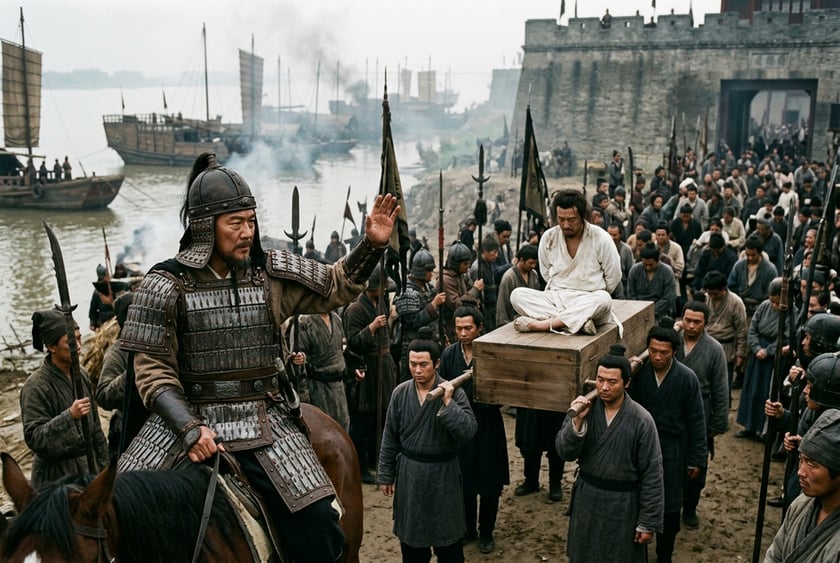
Strategic Background
From the perspective of modern military history, the Battle of Baxi was the most critical and most underestimated engagement in Cao Cao's southward push after seizing Hanzhong. In the third month of the twentieth year of Jian'an (215), Cao Cao personally led his campaign against Zhang Lu; by the seventh month he had stormed Yangpingguan, and in the eleventh month Zhang Lu submitted. Once Cao Cao had completed his disposition of Hanzhong, he followed the counsel of Sima Yi and Liu Ye: seize the moment of Liu Bei's newly consolidated hold on Yizhou, before popular allegiance had solidified, and strike south toward Shu. Yet he could not lead the main force south himself — the Guanzhong and Ye fronts still required his attention — so he ordered Zhang He to advance on Baxi with a detached corps in a probing action. This arrangement of "feeling out with a detached force, main army in reserve" was not uncommon in Cao Cao's military career — the posting of Cao Ren to hold Jiangling after the seizure of Jingzhou followed the same logic. But the critical difference this time was that the detached force's commander, Zhang He, was one of the foremost generals of the age, while Shuhan's governor of Baxi, Zhang Fei, was equally so. Their collision amid the complex terrain of the Ba hills was bound to evolve into a decisive battle far exceeding the scope of a mere probe.
Deployments
On the Wei side, Zhang He divided his force of thirty thousand men among three fortified camps — at Dangqu, Mengtou, and Dangshi — forming a mutually supporting triangle, with Hanzhong's supply lines to his rear and his advance directed toward Langzhong. This "three-camp linked encampment" was the standard mountain-warfare configuration of the Guanzhong army corps: camps could provide mutual fire support and prevent being defeated in detail. The trade-off was dispersal — each camp could marshal fewer than ten thousand men in actual combat. On the Shu side, Zhang Fei personally led ten thousand crack troops thirty li out from Langzhong to meet the enemy, while Lei Tong commanded five thousand elite soldiers as a concealed flanking force. This was the classic Shu-terrain tactic of "engage with the main force, strike with the surprise force" — pin the enemy with regular troops, then cut in from the flank and rear, exploiting the asymmetry of local geographic knowledge to create a killing ground.
Critical Decision Points
The first decision point came after the initial engagement, when Zhang He held his three camps and refused to come out. From a military logic standpoint this was the correct choice: thirty thousand men divided across three defensive camps was a stable posture, Zhang Fei had come far from his main supply base, and time was not on the Shu side. The second decision point was Zhang Fei's daily performance of drinking wine in front of the hills and hurling insults. In modern psychological-warfare terms this was "the use of a conspicuously unprofessional display to induce the opponent to abandon his settled strategy of patient endurance" — Zhang He, watching from the heights as the enemy appeared so undisciplined, would inevitably develop a cognitive bias of "heaven-sent opportunity," causing him to abandon his defensive advantage and come down to raid the camps. That was precisely what Zhang Fei wanted: to draw the enemy out of his positional advantages. The third decision point came when Zhang He, after losing all three camps, fell back to hold Wakouguan — and fell straight into Zhang Fei's combined "counter-deception and encirclement" scheme. Three consecutive defeats reflected Zhang He's accumulated errors under asymmetric geographic intelligence: in the Dangqu hill country he was an outsider, while Zhang Fei had administered Baxi for years and possessed a structural, unrecoverable advantage in knowledge of local terrain — no amount of battlefield improvisation could bridge that gap.
Outcome and Echoes
The most direct result was the near-total annihilation of Zhang He's thirty thousand troops, with Zhang He himself escaping back to Nanzheng with barely a dozen horsemen. The blow this dealt to Wei morale far exceeded the raw loss of men — it directly answered a strategic question: could Wei absorb the outer ring of Yizhou without committing the main force? The answer was no. The following year (216), Cao Cao abandoned his southward drive, returned to Ye, and accepted the Nine Gifts on his way to the title of King of Wei — a political signal that the window for "taking Shu by going south" had closed. The deeper echoes resonate on two levels. First, Zhang Fei's military brand as Shuhan's "flying general" was permanently cast in this battle, completing the trio of defining moments — the slightly earlier Dangyangchangban and the slightly later Battle of Hanzhong — that shaped his strategic image. Second, Wei's failure at Baxi laid bare the true weight of the terrain barrier between Hanzhong and the Shu roads. Liu Bei's group concluded from this that Cao Cao would not lightly march south again, and accordingly felt secure enough to launch the Battle of Hanzhong two years later (217), advancing north on their own initiative. That strategic judgment proved correct: the Battle of Baxi was in fact the distant overture to the Battle of Hanzhong.
Counterfactual Analysis
What if Zhang He had not come down to raid the camps, and instead held to his original plan of "defend the three camps and cut the enemy's supply"? A realistic assessment suggests that Zhang Fei genuinely lacked sufficient logistical preparation for a prolonged siege — the detail in the novel about fifty jars of wine arriving from Chengdu, though it serves as a vehicle for the deception scheme, also hints at a certain fragility in the Shu forward supply line. Had Zhang He ground it out until the following spring, Shu forces might well have been compelled to withdraw to Langzhong. The second fork: what if, after Zhang He's probe failed, Cao Cao had immediately dispatched a relief force — say, Xiahou Yuan or Xu Huang with the main body advancing south — creating a two-tiered "Zhang He plus Xiahou Yuan" army group? Could Liu Bei's forces still have held? That, too, is genuinely uncertain — in that scenario the Battle of Hanzhong would have been fought two years earlier, with the attacker and defender reversed, forcing Liu Bei into a defensive war on Yizhou's own territory. But history offered none of these paths — Cao Cao chose to withdraw north and rest, and in so doing handed the strategic initiative to Liu Bei. Understanding these roads not taken is precisely the way to grasp the true weight of this 215 mountain encounter battle in the broader ten-year strategic balance that followed Chibi.