Background
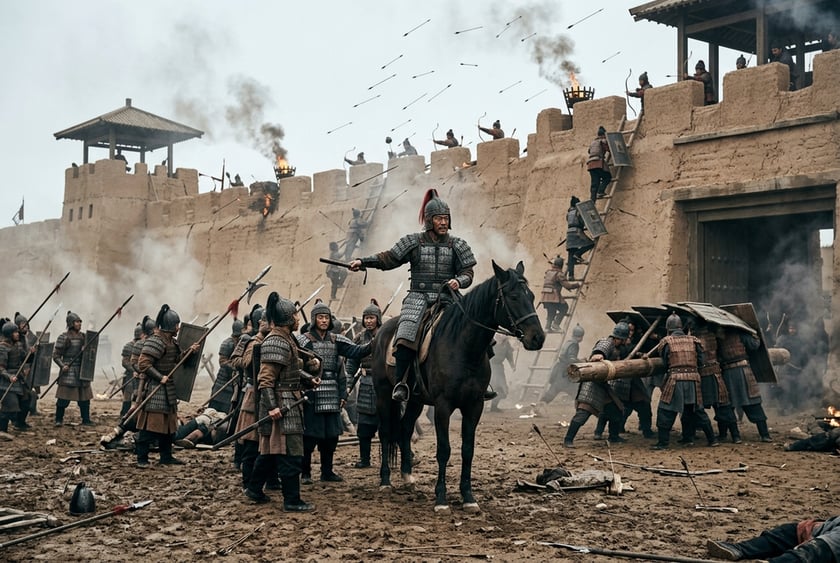
The first year of the Jian'an era was one of the most critical turning points in Cao Cao's career. That year he accomplished two momentous things: he received the Han emperor at Xudou, formally acquiring the political capital to "act in the Son of Heaven's name against the disobedient"; and he conducted a large-scale absorption of the remnant forces of Li Jue and Guo Si, as well as the troops of Yang Feng and Han Xian who had escorted the emperor, laying the personnel foundation for his future campaigns. Xu Huang's defection to Cao Cao is embedded within the series of small engagements during which Cao Cao escorted the emperor back east. The background is that Yang Feng and Han Xian had both originally belonged to Zhang Ji's former forces; after escorting the emperor they then competed with Cao Cao for political position at the emperor's side, and were ultimately defeated militarily. As the most capable general under Yang Feng's command, Xu Huang's allegiance directly determined whether Cao Cao could convert this military victory into a gain in talent [c:16926].
Key Figures
In the novel, Xu Huang makes his debut with a signature image of martial authority and imposing bearing. His bout with Xu Chu lasting more than fifty exchanges without a decisive outcome immediately established his standing in Cao Cao's mind as a "truly excellent general" [c:16926]. This battlefield certification was crucial — it shifted Cao Cao's attitude toward Xu Huang from "an enemy commander to be cut down" to "someone who must be recruited." Man Chong plays the role of a key intermediary in this episode: he had both a personal relationship with Xu Huang from earlier acquaintance and the official standing of an aide under Cao Cao, making him ideally suited for the special mission of "a night visit to persuade surrender." Yang Feng and Han Xian are the losers in this contest for talent; they had failed to build sufficient political commitment with Xu Huang, and in comparison between old and new lords, he tilted toward Cao Cao.
Core Issue
The central issue of this episode is "how to achieve a high-quality talent defection under military pressure." Cao Cao's approach contains several key details worth analyzing. First, he did not choose to "capture and kill to eliminate future trouble" — which at the time would actually have been the simpler course. Second, he did not choose to "press the assault until Xu Huang surrendered" — which would have had Xu Huang come over in humiliation, making it difficult to entrust him with important responsibilities. Third, he chose to send an official with a prior acquaintance to Xu Huang, granting him face and private space to choose via a night visit [c:16927]. Man Chong's rhetoric was also carefully calibrated: he first affirmed Xu Huang's valor and military acumen, then offered an objective assessment that Yang Feng and Han Xian were "not men for founding a great enterprise," and finally dressed the decision to choose a new lord in the elegant phrasing "a fine bird selects the right tree" [c:16928]. This combination of "military pressure plus private persuasion" was Caowei's signature approach to competing for talent, and was employed repeatedly in later cases — Zhang Liao, Zhang He, Jia Xu, and others.
Political Consequences
Xu Huang's defection directly added to Caowei a general of the caliber to stand alongside Xu Chu and Zhang Liao. In the short term, he helped Cao Cao stabilize the military situation during the imperial escort; in the long term, he played decisive roles in key battles at Guandu, Baima, Fancheng, and elsewhere, and was the most consistently effective of the Caowei Five Good Generals [c:16928]. Xu Huang's stance of refusing to kill Yang Feng and Han Xian as a "tribute gift" upon joining deserves particular attention — he voluntarily passed up what would have been an "efficient entry offering" and chose to defect in an honorable manner, a choice that Cao Cao immediately recognized by calling him a "man of righteousness." In the novel's narrative, this posture laid the groundwork for Xu Huang's sustained high level of trust within the Caowei military throughout his long career. By contrast, Lv Bu's path of killing Ding Yuan and Dong Zhuo as tribute gifts upon switching sides caused everyone to remain permanently wary of him — Xu Huang's choice is precisely the inverse case.
Counterfactual Analysis
Had Cao Cao pressed a direct assault on Xu Huang, the most likely outcome would have been Xu Huang's death in battle or capture while wounded — Caowei would have lost an excellent general, and Xu Chu would not necessarily have emerged unscathed either. Had Man Chong attached the condition "kill Yang Feng as your entry tribute" to his persuasion, Xu Huang would very likely have refused and chosen to fight to the death — the novel makes clear he explicitly rejected any such arrangement. Had Xu Huang not defected but instead been taken away by Yang Feng and Han Xian to continue resistance, he would in all probability have spent his life consumed in piecemeal fashion across the turbulent era, never achieving great things. Seen from this angle, Xu Huang's defection to Cao Cao was a talent migration in which both parties obtained the best possible outcome: Caowei gained a field commander of lasting value, and Xu Huang obtained a stage on which to fully deploy his military ability. This recruitment case also became a classic footnote to the "capable official in an age of order, wily hero in an age of chaos" assessment of Cao Cao — he was not bloodthirsty; on the contrary, in multiple instances he displayed patience and calculated precision in his pursuit of talent. From a broader historiographical perspective, the historical record's account of Xu Huang's defection to Cao Cao is broadly consistent with the novel's version, with no major divergences on key facts; the novel's main additions are the detail of Man Chong's night visit and a dramatized treatment of Xu Huang's personal speech.