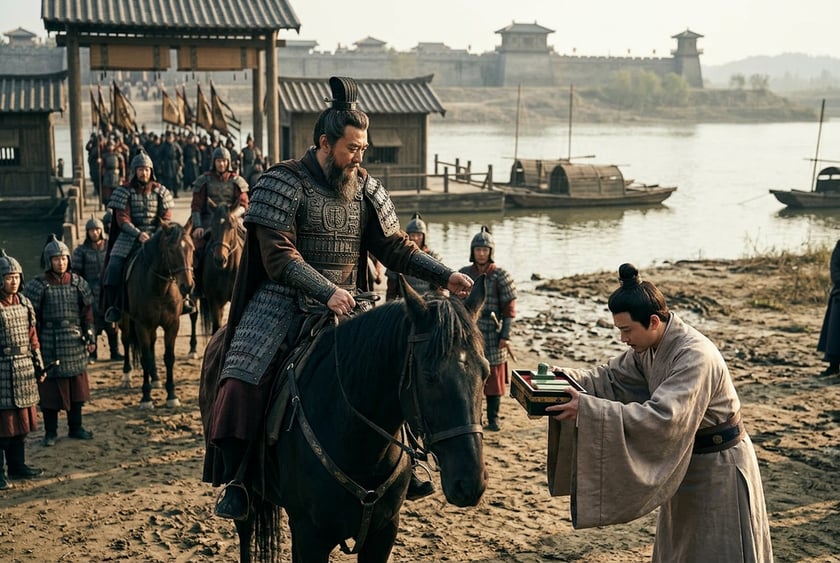
Strategic Background
The Battle of Xiaoyaojin was the climax of the Hefei siege campaign in the twentieth year of Jian'an (215) and the most emblematic moment of Sunwu's northern advance being turned back in the entire San Guo era. That year, the Wu–Liu alliance had just resolved the question of Jingzhou's ownership through the "Xiangshui Pact" — Sun Quan returned the eastern portions of Jingzhou (Guiyang, Changsha) to Liu Bei in exchange for partial administrative rights over Jiangxia, Changsha, and Lingling. With tensions toward Liu Bei thus defused, Sun Quan immediately shifted his strategic center of gravity northward, marshaling the full resources of his state to strike at Hefei while Cao Cao led his main force westward against Zhang Lu in Hanzhong. This was the moment in Sun Quan's life when he came closest to "seizing Huainan and altering the San Guo balance" — had Hefei fallen, Sunwu power would have pushed into the Jianghuai plain and Caowei's entire southern line would have collapsed. Yet what confronted him was the defensive system Cao Cao had painstakingly constructed — Zhang Liao, Li Dian, and Le Jin paired with the sealed instructions — together with the battlefield chemistry among those three commanders that history has celebrated as the "Three Elders of Hefei." The result was a military legend of the few defeating the many.
Troop Dispositions
On the Wu side: Sun Quan personally commanded a hundred thousand troops (the romance's inflated figure; the actual count was somewhere between seventy and a hundred thousand), with principal commanders Lv Meng, Ling Tong, Gan Ning, Zhou Tai, Jiang Qin, Chen Wu, Xu Sheng, Pan Zhang, and others — virtually every front-line Wu general of the day. This "full all-star lineup" reflected Sun Quan's absolute determination but also exposed a hidden vulnerability: the force was dominated by naval commanders with few siege specialists. The Wu army advanced from Ruxu northward, reached the northern shore of Chaohu, and pressed its main strength against Hefei to begin the siege. On the Caowei side: the Hefei garrison numbered some seven thousand, jointly commanded by Zhang Liao, Li Dian, and Le Jin. Before Cao Cao left on campaign, he had entrusted Xue Ti with a sealed letter: "If the enemy comes, Zhang and Li shall go out to fight; Le Jin shall defend the city; the Palace Overseer shall not engage in battle" — this pre-assigned division of roles prevented the three commanders from falling into disputes under pressure. In raw numbers Caowei was at an extreme disadvantage of one to ten; in command structure, however, it enjoyed crystal-clear wartime roles and a high degree of mutual trust among its generals.
Critical Decision Points
The first critical decision was Zhang Liao's choice to sortie. When facing an enemy ten times his strength, most commanders would choose passive defense; Zhang Liao instead judged that "the enemy are many and we are few — we must break their momentum to steady the hearts of our men" — meaning that only by knocking out the Wu army's initial surge of fighting spirit could the garrison sustain its subsequent defense. This was a psychological assessment of the highest order in military art. The second decision was the night recruitment of eight hundred volunteers and the dawn raid on the Wu camp. Zhang Liao personally led the charge, cut down dozens of Wu soldiers, and burst through to the very entrance of Sun Quan's command tent — this kind of "commanding general risking his own life in the fight" was extremely rare among Caowei commanders, most of whom preferred to direct from the rear. Zhang Liao's choice to lead from the front was in essence using "the commander's personal combat" to offset "the disparity in numbers," and the result was to knock out the Wu army's initial offensive energy in a single stroke. The third decision was Sun Quan's faulty troop disposition during the withdrawal. After more than ten days of failed siege, Sun Quan decided to retreat — but chose to personally hold the rear at Xiaoyaojin. The motivation behind this choice is complex: it may have been a gesture of "protecting the army with his own body," or perhaps an underestimation of Zhang Liao's boldness in pursuit. The outcome was that the main army pulled back first, leaving Sun Quan and a small personal guard exposed to Zhang Liao's ambush and his blocking of the bridge. The fourth decision was the desperate rear-guard combat of Ling Tong, Gan Ning, and Gu Li. Ling Tong led his three-hundred-strong personal guard in a bloody stand against Zhang Liao's men, with nearly all of his escort dying in the fight; Gu Li struck Sun Quan's horse from behind to make it leap the partially demolished Xiaoyaojin bridge, giving Sun Quan the margin to escape — this "sacrificial protection of the sovereign" was the only reason Sun Quan came out of the trap alive.
Outcome and Repercussions
Tactical outcome: tens of thousands of Wu troops were killed, senior commanders including Chen Wu fell in battle, and Sun Quan's personal reputation suffered lasting damage; Hefei remained intact. The strategic consequences were fourfold. First, after this defeat, Sunwu's assaults toward Hefei became notably more cautious; never again did Sun Quan personally lead a campaign with his entire roster of generals in a single all-out strike. Second, Zhang Liao personally became the emblematic figure of Caowei's southern line — his fame spread into Sunwu's civilian population, giving rise to the legend of "Zhang Liao stopping children's crying"; in the twenty-first year of Jian'an, when Cao Cao returned from his western campaign, he made a special trip to inspect Hefei in person, publicly commending Zhang Liao's achievement as a "model of military command" — an important component of Caowei's later system for inspiring its commanders. Third, Sun Quan's confidence in "commanding a great host himself" evaporated, and he shifted toward trusting the independent command of a younger generation of generals — Lv Meng and Lu Xun — which indirectly enabled the success of Lv Meng's seizure of Jingzhou in the twenty-fourth year of Jian'an; the debacle of Xiaoyaojin taught Sun Quan the more prudent strategic style of "trusting commanders in the field while sitting firmly in the rear." Fourth, the Hefei defensive model became admired by later generations: discussions of city-defense tactics in the Ming and Qing dynasties still cited Xiaoyaojin as the classic case of "breaking a siege through active sorties," and Zeng Guofan's Xiang Army field manual also drew on this battle.
Counterfactual Analysis
Counterfactual one: had Zhang Liao failed to break through the Wu vanguard — had he instead been killed during that desperate charge — Caowei's southern line would have lost its strongest commander, and Sun Quan might have used that opportunity to actually take Hefei. In that scenario Sunwu power would have expanded into the Jianghuai plain, and the San Guo balance might have evolved toward a configuration in which all three states controlled roughly equal territories, rather than the actual situation in which Caowei dominated two-thirds of China. Counterfactual two: had Sun Quan been captured or killed by Zhang Liao at Xiaoyaojin — not an entirely impossible outcome, since Zhang Liao's charge brought him within dozens of paces of Sun Quan — the Sunwu regime would have faced a severe succession crisis. Sun Quan's eldest son, Sun Deng, was only seven years old at the time and could not have held things together; Sun Ce's surviving son Sun Shao might have been pushed forward as a successor, but the political tensions between Sun Quan's branch and Sun Ce's branch would have erupted immediately, potentially fragmenting Wu or delivering it to Caowei in a single blow. Counterfactual three: had the personal guards of Ling Tong, Gu Li, and the others also failed in their last stand, and had Sun Quan's horse not cleared the Xiaoyaojin bridge, the cascading consequences for Wu of losing its sovereign would be the same as above. These three counterfactuals together establish one fact: the outcome at Xiaoyaojin was not merely a regional engagement — it was a critical node capable of determining the entire San Guo balance. Zhang Liao's feat of routing a hundred thousand with eight hundred was not only a military marvel but a manifestation of history's contingency.