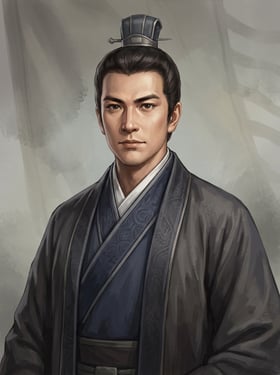
Historical Record
Dong Yun, styled Xiuzhao, was the son of Dong He, the General of the Household Who Directs the Army. When the Former Lord Liu Bei established the Crown Prince, Dong Yun was chosen as a Retainer, and later promoted to Master of the Horse. After the Later Lord Liu Shan ascended the throne, he was promoted to Gentleman of the Yellow Gate. When the Chancellor Zhuge Liang was preparing for his Northern Expeditions and stationed at Hanzhong, considering that the Later Lord Liu Shan was young and hard-pressed to distinguish right from wrong, he recommended the impartial and fair-minded Dong Yun to take charge of palace affairs. Zhuge Liang memorialized, pointing out: "The Palace Attendants Guo Youzhi and Fei Yi, and the Gentleman of the Palace Dong Yun, are men selected by the Former Emperor and left to Your Majesty; they can weigh what is beneficial and offer loyal counsel. I believe that in palace matters, great or small, all should be consulted with them, which will surely make up for omissions and bring broad benefit. If there be no words conducive to virtue, then Dong Yun and the others should be punished to make plain their negligence." Zhuge Liang then requested Fei Yi to serve as Army Adviser, while Dong Yun was promoted to Palace Attendant and concurrently General of the Household of the Rapid as Tigers, commanding the palace guards. Guo Youzhi was mild and compliant in nature, merely making up the numbers, while the responsibility of presenting counsel fell solely to Dong Yun. In handling affairs, Dong Yun emphasized guarding against and restraining wrongs, and did his utmost to set things right. The Later Lord Liu Shan once wished to select women to fill the rear palace, but Dong Yun held that in antiquity the number of a Son of Heaven's consorts did not exceed twelve, and that the consorts now were already sufficient and should not be increased, and to the end he firmly refused to comply. The Later Lord therefore held him in even greater awe. When the Prefect of the Masters of Writing Jiang Wan concurrently held the post of Inspector of Yi Province, he once memorialized to defer to Fei Yi and Dong Yun, and memorialized that "Dong Yun has attended within the palace for many years and assisted the royal house; he ought to be granted rank and land to reward his merit." But Dong Yun firmly declined and would not accept. As the Later Lord Liu Shan gradually grew older, he came to favor the eunuch Huang Hao. Huang Hao was flattering and cunning, scheming by every means to rise. Dong Yun would constantly admonish the sovereign above with a stern countenance, and below repeatedly reprimand Huang Hao. Huang Hao therefore feared Dong Yun and dared not act recklessly. While Dong Yun lived, Huang Hao's office never rose above Assistant of the Yellow Gate. In the sixth year of Yanxi, Dong Yun was additionally appointed General Who Upholds the State. In the seventh year of Yanxi, he concurrently held the office of Prefect of the Masters of Writing in his capacity as Palace Attendant, becoming the deputy of the Grand General Fei Yi. In the ninth year of Yanxi, Dong Yun died. At the time, the people of Shu spoke of Zhuge Liang, Jiang Wan, Fei Yi, and Dong Yun together as the "Four Chancellors," also called the "Four Heroes."
In the Novel
In Romance of the Three Kingdoms, Dong Yun's image likewise upholds the loyalty and uprightness of the historical record. In the eighth month of the first year of Jianxing (223 CE), when Wei mustered a great army on five routes to invade the Western River lands, the Later Lord Liu Shan was anxious because Zhuge Liang "had taken ill and would not come out." He dispatched the Gentleman of the Yellow Gate Dong Yun and the Grand Counselor Du Qiong to go to the Chancellor's residence to inquire. Dong and Du were unable to see Zhuge Liang, and Du Qiong lamented the gravity of the Former Emperor's charge entrusting the orphan, yet the Chancellor pleaded illness and would not come out. Dong Yun, however, showed his trust in Zhuge Liang, advising the Empress Dowager: "Your Ladyship should not go lightly. I reckon the Chancellor must have some brilliant plan. Let us wait for the sovereign to go first. If he is found negligent, then it will not be too late for Your Ladyship to summon and question the Chancellor in the ancestral temple." This passage displays Dong Yun's firm confidence in Zhuge Liang's wisdom, and also reflects his caution as a close minister and his protectiveness of his sovereign. After Zhuge Liang's death, a conflict broke out between Yang Yi and Wei Yan, and the two impeached each other in memorials. Dong Yun, together with Jiang Wan, analyzed the situation for the Later Lord Liu Shan, holding that Wei Yan "relies on his high merit and often harbors discontent, uttering resentful words. The reason he did not rebel before was his fear of the Chancellor. Now that the Chancellor has newly died, his taking the opportunity to make disorder is inevitable." He vouched that Yang Yi would not rebel, and pointed out that Yang Yi was a man employed by the Chancellor. The Later Lord Liu Shan adopted their advice and ordered Dong Yun to go bearing the imperial credentials to persuade Wei Yan; but this act has no clear record in history and belongs to the literary creation of the novel. This further reinforces Dong Yun's important position in the later political situation of Shu Han and his contribution to stabilizing affairs.
Key Relationships
* Dong He (parent of): Dong Yun was the son of Dong He, the General of the Household Who Directs the Army; this father-son relationship is clearly mentioned in the historical record, laying the foundation of Dong Yun's background.
* Shu Han (serves): Dong Yun served the Shu Han regime throughout his life—from Retainer and Master of the Horse in the time of the Former Lord Liu Bei, to Gentleman of the Yellow Gate, Palace Attendant, and Prefect of the Masters of Writing in the time of the Later Lord Liu Shan—always an important official of Shu Han, wholeheartedly assisting the administration.
* Huang Hao (enemy of): There was a clear antagonistic relationship between Dong Yun and the eunuch Huang Hao. Dong Yun "above admonished the sovereign with a stern countenance, and below repeatedly reprimanded Huang Hao," so that while Dong Yun lived, Huang Hao dared not do evil and his office could not rise. This relationship reflects Dong Yun's impartial, selfless character and his daring to remonstrate frankly.
* Liu Shan (advises in): As Palace Attendant, Dong Yun repeatedly remonstrated with the Later Lord Liu Shan, especially on the matter of selecting women for the rear palace, where he "to the end firmly refused to comply," so that Liu Shan "held him in ever greater awe". In Romance of the Three Kingdoms, Dong Yun also analyzed the conflict between Wei Yan and Yang Yi for Liu Shan and offered advice.
* Zhuge Liang (recommended by): Zhuge Liang's trust in and esteem for Dong Yun was key to his career. Before his Northern Expeditions, Zhuge Liang specially memorialized to recommend Dong Yun, holding that he was "impartial and fair-minded" and could be entrusted with the affairs of the palace.
* Fei Yi (colleague of): Dong Yun and Fei Yi were both close ministers recommended by Zhuge Liang, jointly assisting the Later Lord within the palace. Dong Yun later also served as deputy to the Grand General Fei Yi.
* Jiang Wan (colleague of): Jiang Wan once memorialized to commend Dong Yun's merit and suggested granting him rank and land, but Dong Yun firmly declined. In Romance of the Three Kingdoms, the two also jointly analyzed Wei Yan's rebellion for Liu Shan.
* Guo Youzhi (colleague of): Guo Youzhi and Dong Yun were both Palace Attendants recommended by Zhuge Liang, but the histories record that Guo Youzhi was "by nature mild and compliant, merely making up the numbers," while Dong Yun "took sole charge of the responsibility of presenting counsel".
* Wei Yan (advises on, in): In Romance of the Three Kingdoms, Dong Yun once advised Liu Shan on the matter of Wei Yan's rebellion and was sent to persuade Wei Yan (unique to the novel).
* Yang Yi (advises on, in): In Romance of the Three Kingdoms, Dong Yun vouched that Yang Yi would not rebel and pointed out that he was capable and quick-witted.
Iconic Scenes
* Admonishing the sovereign with a stern countenance, refusing to add consorts: When the Later Lord Liu Shan wished to expand the rear palace, Dong Yun firmly upheld the ancient institution, holding that "the consorts now are already sufficient and should not be increased," and "to the end firmly refused to comply," so that Liu Shan "held him in ever greater awe." This scene fully displays Dong Yun's upright and unbending character: even before his sovereign, he would not yield, preserving the clarity of the court's governance.
* Curbing Huang Hao, so he dared not do evil: While Dong Yun lived, facing the eunuch Huang Hao whom Liu Shan favored, he "above admonished the sovereign with a stern countenance, and below repeatedly reprimanded Huang Hao," so that Huang Hao "feared Dong Yun and dared not do evil," and his office never rose above Assistant of the Yellow Gate. This was Dong Yun's important contribution to maintaining the political clarity of Shu Han, and reflects his firm stance against evil forces.
* Unyoking his carriage horse to honor a humble man, valuing fellowship over feasting: Once, when Dong Yun and Fei Yi and others were about to go out for an excursion and feast and the carriages were already prepared, the Gentleman of the Interior Dong Hui came to visit. Dong Hui, young and of low office, wished to take his leave on seeing Dong Yun about to go out. But Dong Yun would not allow it, saying, "I had meant to go out to talk and roam with my friends; now that you have condescended to come, this is just the time for a good conversation. To abandon this talk and go off to a feast is not my wish." He then ordered the horses unyoked, and Fei Yi and the others thereupon canceled their outing. This scene vividly portrays Dong Yun's gentlemanly bearing of upholding rectitude, deferring to the humble, and valuing fellowship over feasting.
* Zhuge Liang entrusts the orphan; palace matters all consulted with him: Before his Northern Expeditions, knowing the Later Lord to be young, Zhuge Liang specially memorialized to recommend Dong Yun, calling him "impartial and fair-minded," and advising that "in palace matters, great or small, all should be consulted with him, which will surely make up for omissions and bring broad benefit." This was not only Zhuge Liang's high trust in Dong Yun but also established Dong Yun's core position in the later politics of Shu Han.
* In the novel, vouching for Yang Yi and persuading Wei Yan: In Romance of the Three Kingdoms, after Zhuge Liang's death, when Wei Yan and Yang Yi came into conflict, Dong Yun, together with Jiang Wan, analyzed the situation for Liu Shan, vouched for Yang Yi, and was sent by Liu Shan to persuade Wei Yan (unique to the novel). Although this episode has no clear historical record, it further shapes Dong Yun's image as one who stabilizes the court and distinguishes right from wrong at a moment of crisis.
Portrait file
Character profile
- Character
- Upright and impartial in heart, he devoted his full efforts to setting things right; he could correct his sovereign with a stern countenance, repeatedly reproved Huang Hao, upheld rectitude and was humble toward men of talent, and firmly declined the rank and lands offered him. Ranked alongside Fei Yi, he was a chief minister of Shu Han.
- Manner of speech
- With a stern countenance he corrected his sovereign, and repeatedly reproved the eunuchs.
- Life
- Son of Dong He, he was chosen as a retainer (sheren) when the former sovereign established the heir apparent, and later promoted to Master of the Stables (xima). After the later sovereign succeeded to the throne, he was promoted to Gentleman Attendant of the Yellow Gate; when Chancellor Zhuge Liang went on his northern campaigns, he recommended him to take charge of palace affairs. He was later promoted to Palace Attendant and concurrently General of the Rapid Tigers commanding the guard troops. In the sixth year of Yanxi he was additionally made General Who Upholds the State, and in the seventh year, as Palace Attendant acting as Prefect of the Masters of Writing, he served as deputy to Grand General Fei Yi; he died in the ninth year.
- Anecdotes
- The people of Shu ranked him together with Zhuge Liang, Jiang Wan, and Fei Yi as the "Four Chancellors," styling them the "Four Paragons." During his lifetime, Huang Hao's post never rose above Assistant of the Yellow Gate.
Relationships
7 relationships
Family1
Friends2
Enemies1
Teacher & student1
Other2
Lines
- 演 ch.85 §25→ Lady Wu📍 Chengdu
娘娘未可輕往。臣料丞相必有有高明之見。且待主上先往。如果怠慢,請娘娘於太廟中,召丞相問之未遲。
- 演 ch.105 §8📍 Chengdu
「魏延自恃功高,常有不平之心,口出怨言。向所以不即反者,懼丞相耳。今丞相新亡,乘機為亂,勢所必然。若楊儀才幹敏達,為丞相所任用,必不背反。」
Chapters3 回 ▸
- 史ch.39
- 演ch.85ch.105
Relationship timeline4 条 ▸
Inner monologues · AI-generated1 段 ▸
- I am Dong Yun, courtesy name Xiuzhao. Whenever I think of how the late emperor promoted me to Gentleman of the Heir Appa
Life events3 ▸
- 0227-01-01 · ChengduFormer Memorial on Sending Out the Troops· Advisor
- 0231-01-01 · YonganLi Yan Dismissed for Failing to Deliver Supplies on Time· Witness
- 0263-01-01 · ChengduHuang Hao's Usurpation of Power· Advisor