Historical Record
Cao Mao, styled Yanshi, was the grandson of Emperor Wen of Wei, Cao Pi, and the son of Cao Lin, Prince Ding of Donghai. In the fifth year of the Zhengshi era (244), he was enfeoffed as Duke of Gaogui Township in Chu County. From childhood Cao Mao was fond of learning and precociously bright. After Cao Fang, Prince of Qi, was deposed, the nobles and ministers deliberated and welcomed Cao Mao to the throne. In the tenth month of the first year of the Jingyuan era (260), on the day jichou, Cao Mao arrived at the Xuanwu Lodge. The assembled officials petitioned him to take up residence in the front hall, but he, citing it as "the late emperor's former dwelling," withdrew to lodge in the western wing. The officials again requested that he be received with the imperial carriage and escort, but Cao Mao did not comply. On the day gengyin, Cao Mao entered Luoyang, and the officials greeted and bowed to him south of the Xiye Gate. Cao Mao alighted from his carriage to return the bows; the master of ceremonies dissuaded him, saying "protocol does not require you to bow," but Cao Mao insisted, "I am a subject," and returned the bows. When he reached the Zhiche Gate and alighted, his attendants urged him to ride his carriage inside, but Cao Mao said, "I have been summoned by the Empress Dowager, and do not yet know what is required of me!" and so proceeded on foot to the Taiji Eastern Hall to have audience with the Empress Dowager. That same day, Cao Mao ascended the imperial throne in the Taiji front hall, granted a general amnesty, and changed the reign title to Zhengyuan. After his accession he reduced the expenditures on the imperial carriages, robes, and the harem, and abolished extravagant and useless items in the imperial workshops and storehouses.
During his reign, Cao Mao displayed a keen interest in learning and a sharp capacity for reasoning. He once visited the Imperial Academy and questioned the scholars on difficult points in the Book of Changes and the Book of Documents — such as Fuxi's composition of the Changes, Confucius's composition of the Tuan and Xiang commentaries not according with the text, and the Yellow Emperor, Yao, and Shun governing the realm merely by letting their robes hang down — and on all of these he was able to put forward original views that the academicians found hard to answer in full. He also raised doubts concerning Zheng Xuan's and Wang Su's interpretations of "examining antiquity, equal to Heaven" in the Book of Documents, and concerning historical events such as Yao and Shun employing Gun and recommending Shun, showing that he did not slavishly follow convention but had his own thinking. In addition, Cao Mao once visited the Biyong academy and ordered the assembled officials to compose poems; toward officials such as the Palace Attendant He You and the Master of Writing Chen Qian, who were slow in composing their poems, he pardoned their fault and encouraged the officials to refine and illuminate the classics.
However, Cao Mao's reign was always overshadowed by the power of the Sima clan. In the first year of the Ganlu era (256), Sima Zhao routed Jiang Wei at Shanggui, and Cao Mao issued an edict commending him. The following year, Zhuge Dan raised troops in Huainan in revolt against Sima Zhao, and Cao Mao was forced to go in person, together with the Empress Dowager, to Xiang City to display a personal campaign. Even so, real power remained in Sima Zhao's hands. In the fifth year of the Ganlu era (260), in the fifth month on the day jichou, Cao Mao, embittered by Sima Zhao's monopoly of power, finally attempted to march against Sima Zhao, but was killed by Cheng Ji in the clash, aged only twenty. The Empress Dowager ordered him buried with the rites of a commoner, and accused Cao Mao of a "temperament violent and cruel, growing worse by the day," with the intent to harm the Empress Dowager and Sima Zhao.
In the Novel
In Romance of the Three Kingdoms, Cao Mao's accession and end are given greater dramatic color and tragic weight. In the novel, after Sima Shi deposed Cao Fang, he wished to install Cao Ju, Prince of Pengcheng, but the Empress Dowager strongly advocated installing Cao Mao, Duke of Gaogui Township, and was supported by Sima Fu. When Cao Mao first ascended the throne, he displayed a character humble, courteous, and free of vanity — for example, when received upon his arrival he insisted on returning the courtesies, declined to enter the palace by carriage, and walked to the Taiji Eastern Hall. The Empress Dowager also praised him as having "the countenance of an emperor" and placed high hopes in him.
However, the power of the Sima clan is depicted as even more domineering in the novel. After Sima Shi died of illness, Sima Zhao succeeded as Grand General; although Cao Mao tried to detain Sima Zhao at Xuchang to guard against Eastern Wu, Sima Zhao, on Zhong Hui's advice, still led his army back to Luoyang, further consolidating his power. When Zhuge Dan revolted, Sima Zhao went so far as to require the Empress Dowager and Cao Mao to take the field with him in person, ostensibly to "follow the example of the former rulers," but in reality holding the emperor hostage to command the lords.
Cao Mao's death is one of the most tragic scenes in the novel. In the fifth year of the Ganlu era (260), Sima Zhao mounted the hall with his sword, and the officials petitioned to enfeoff him as Duke of Jin and grant him the Nine Bestowals. Cao Mao lowered his head and said nothing; Sima Zhao questioned him sternly, and Cao Mao was forced to consent. Sima Zhao further referred to the poem "Hidden Dragon," implying that Cao Mao had likened him to a "loach and eel," then sneered and descended the hall, which caused Cao Mao to erupt entirely. Cao Mao summoned three men — Wang Chen, Wang Jing, and Wang Ye — and wept as he denounced Sima Zhao's usurping designs, resolving to march against him. Wang Jing earnestly remonstrated against it, but Cao Mao's mind was made up, and he declared, "If this can be endured, what cannot be endured?! My mind is fixed; even death holds no fear!" Wang Chen and Wang Ye betrayed Cao Mao and informed Sima Zhao. Cao Mao led several hundred household servants and palace attendants and sallied forth with clamor; Wang Jing prostrated himself before the carriage and tearfully remonstrated, but Cao Mao did not heed him. In the end, beneath the South Gate Tower, he encountered the palace guards led by Jia Chong. Jia Chong incited Cheng Ji, and Cheng Ji ran Cao Mao through with a halberd, the blade passing out through his back, and Cao Mao died beside his carriage. On hearing the news, Sima Zhao feigned great alarm, knocked his head against his carriage and wept, and brought Wang Jing to punishment. The novel's depiction strenuously dramatizes Cao Mao's grief and resolve, and Sima Zhao's hypocrisy and cruelty.
Key Relationships
* Cao Wei (lord_of): As emperor of Cao Wei, Cao Mao was nominally the master of the realm, but real power had slipped away from him.
* Sima Zhao (enemy_of): Cao Mao and Sima Zhao were mortal political enemies. Sima Zhao held all the power and hollowed out the emperor's authority, ultimately bringing about Cao Mao's tragic end.
* Cao Lin (kin_of): Cao Mao's father, Prince Ding of Donghai.
* Cao Pi (kin_of): Cao Mao's grandfather, Emperor Wen of Wei.
* The Empress Dowager (political patron / nominal supporter): After Cao Fang was deposed, the Empress Dowager strongly advocated welcoming Cao Mao to the throne, but after Sima Zhao monopolized power she too became a tool under his control; indeed, after Cao Mao's death, she issued an edict accusing him of a "violent and cruel temperament," exonerating Sima Zhao.
* Wang Chen, Wang Ye (the betrayers): When Cao Mao resolved to march against Sima Zhao, these two men informed Sima Zhao, directly causing Cao Mao's failure and death (unique to the novel).
* Wang Jing (the loyal minister): When Cao Mao resolved to march against Sima Zhao, Wang Jing earnestly remonstrated against it, but after Cao Mao's mind was fixed he still followed him, and was ultimately brought to punishment by Sima Zhao (unique to the novel).
* Cheng Ji (the assassin): Sima Zhao's officer who directly killed Cao Mao.
* Jia Chong (the instigator): Incited Cheng Ji to kill Cao Mao.
Iconic Scenes
* Humble accession: When Cao Mao was welcomed to the throne, he insisted on returning the bows of the officials, declined to enter the palace by carriage, and walked to the Taiji Eastern Hall, displaying a character humble and free of vanity.
* Debate at the Imperial Academy: Cao Mao's debate with the scholars at the Imperial Academy over the Book of Changes and the Book of Documents displays his fondness for learning, his skill in reasoning, and his precociously mature talent.
* Personal campaign in Huainan: When Zhuge Dan revolted, Cao Mao went in person to Xiang City together with the Empress Dowager, ostensibly a personal campaign but in reality held hostage by Sima Zhao, highlighting his helplessness as a puppet emperor (unique to the novel).
* Denouncing Sima Zhao: When Sima Zhao mounted the hall with his sword and the officials petitioned to grant him the Nine Bestowals, Cao Mao, though forced to consent, finally erupted in the face of Sima Zhao's step-by-step pressure, summoning his confidants to plot his downfall — displaying his "rash and impetuous" side.
* Assassination at the South Gate: Cao Mao led several hundred men out of the palace to march against Sima Zhao, encountered Jia Chong and Cheng Ji beneath the South Gate Tower, and was finally run through by Cheng Ji's single halberd — the climax of his tragic destiny, and the swan song of his resistance to the Sima clan's tyranny.
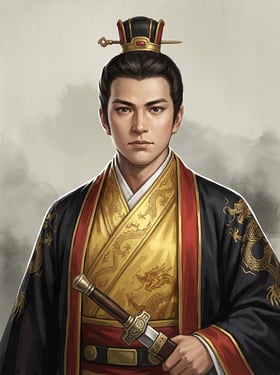
Portrait file
Character profile
- Character
- Cao Mao was of precocious talent and wisdom, fond of inquiry and given to eloquence, gentle, reverent, and yielding. Unwilling to endure disgrace, he wept and said, "If this can be borne, what cannot be borne?" and, sword in hand, led the palace guards to attack Sima Zhao.
- Manner of speech
- Learned and eloquent in the classics, he compared himself to Shaokang and Emperor Gao of Han. When faced with Sima Zhao's coercion, he once declined, saying, "The Grand General commands the armies and horses of all under heaven, to be dispatched at will—why need I go myself?"
- Life
- Cao Mao was a grandson of Emperor Wen and the son of Lin, the Ding Prince of Donghai. In the fifth year of Zhengshi he was enfeoffed as Duke of the Gaogui District of Qi County. After the Prince of Qi was deposed, he was welcomed and installed as the new sovereign, and changed the era name to Zhengyuan. In the fifth year of Ganlu, he personally led his servants to attack Sima Zhao, and was assassinated by Cheng Ji below the Southern Gate-tower, aged only twenty.
- Anecdotes
- Zhong Hui appraised him: "In talent the equal of Chensi, in valor resembling the Grand Progenitor." As the fourth emperor of Cao Wei (the Duke of the Gaogui District), during his reign he advanced Lu Yu to Marquis of Daliang District and Rou to Marquis of Anguo, and issued edicts commending Deng Ai and Zhong Hui.
Relationships
10 relationships
Quotes
44 recorded lines · 3 featured
「司馬昭將懷篡逆,人所共知!朕不坐受廢辱,卿等可助朕討之!」
Cao Mao openly denounces Sima Zhao's treasonous ambition, displaying his imperial integrity and spirit of resistance.
「是可忍也,孰不可忍也!朕意已決,便死何懼!」
'If this can be endured, what cannot be endured?' quotes the classics to express Cao Mao's grief and indignation at being pushed past all endurance.
「匹夫敢無禮乎!」
'How dare a common churl be so insolent!' is Cao Mao's furious rebuke on the verge of death, manifesting his unyielding imperial dignity.
Chapters9 回 ▸
- 史ch.4ch.20ch.27ch.28
- 演ch.109ch.110ch.111ch.112ch.114
Relationship timeline6 条 ▸
Inner monologues · AI-generated3 段 ▸
- I was chosen in accordance with the late emperor’s final wishes to succeed to the principal line. Though young, I occupi
- The imperial entourage was stationed at Xiangcheng, where the sounds of the Huainan armies could be heard. As Son of Hea
- I was born in the third year of Zhengshi. My courtesy name was Yanshi, and I was the grandson of Wen Di and the son of L
Life events5 ▸
- 0254-01-01 · LuoyangSima Shi Deposes Cao Fang· Witness
- 0254-01-01 · LuoyangDeposition of Cao Fang
- 0258-01-01 · LuoyangZhuge Dan's Rebellion· Witness
- 0260-01-01 · LuoyangCao Mao Rides Out in His Chariot to Battle· Commander
- 0260-01-01 · LuoyangGanlu Incident· Victim