Strategic Background
The Battle of Wancheng may appear to be a siege decided in a matter of hours, but behind it lies a microcosm of seven years of back-and-forth across the Jianghuai front after Chibi. In the nineteenth year of Jian'an (214), the Jianghuai region was in a precarious equilibrium: though Caowei had suffered setbacks at Chibi, the Hefei defensive line, held by Zhang Liao, Le Jin, and Li Dian, had become an iron barrier blocking Sunwu's northward advance. Meanwhile, Caowei had installed Zhu Guang as the Lujiang Administrator at Wan (modern Qianshan, Anhui), opening up paddy fields on a large scale and recruiting rebel chiefs from the Poyang Lake region as internal agents — in essence driving a stake into the north bank of the Yangtze, bundling together agricultural resources, an intelligence network, and a potential internal rebellion all into one push. Geographically, Wancheng lay in the interior, on the Wan River's approach to the Yangtze, only a few dozen li from the river bank; if Caowei established a productive foothold there, Sunwu's reconnaissance depth on the northern bank would be compressed, and unrest among the mountain peoples (Shanyue) and clan militias in the Poyang region would be manipulated by outside forces. Lv Meng's judgment that "if one harvest completes there, those forces will inevitably multiply; in a matter of years, Cao Cao's designs will be plain" was his recognition that this was a threat that would grow geometrically with time — which is why what he advocated was not "capturing a single city" but "pulling out this stake before the threat can ferment".
Deployments
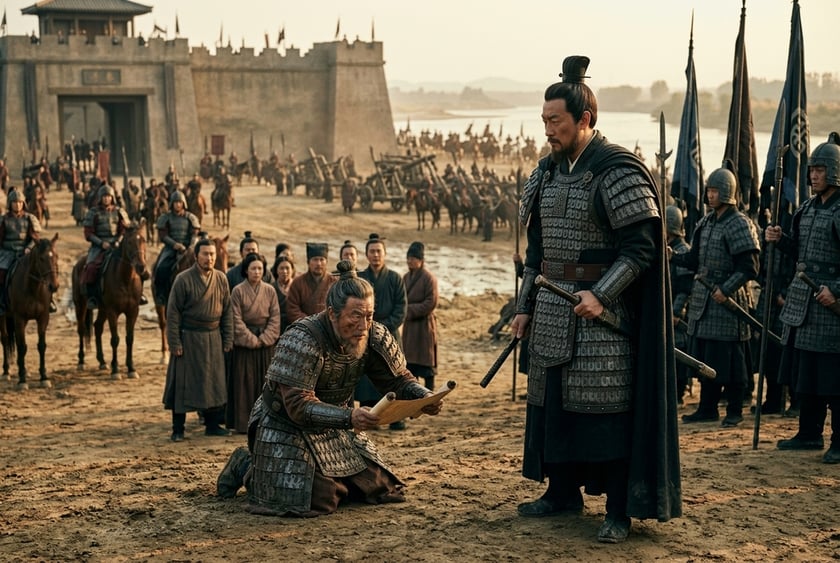
The Sunwu side committed forces of extremely high caliber: Sun Quan commanded the campaign in person, both Lv Meng and Gan Ning — the two most formidable of Sunwu's commanders — were deployed simultaneously, and the Romance records the accompanying roster of Jiang Qin, Pan Zhang, Zhou Tai, Chen Wu, Dong Xi, and Xu Sheng — a full-strength assembly of principal forces. This configuration of "supreme commanders plus elite troops" thrown against a single small city was highly unusual in the post-Chibi years and reflected Sun Quan's agreement with Lv Meng about the strategic value of Wancheng. The Caowei defending commander Zhu Guang was structurally disadvantaged — he had to manage paddy cultivation, handle his internal-agent network, and garrison the position simultaneously, with these three tasks pulling against each other; the construction of the city's defenses had consequently lagged. The supporting force under Zhang Liao moving south from Hefei was separated from Wancheng by the dangerous mountain passes of Jiashi (north of modern Tongcheng, Anhui), leaving insufficient reaction time. In the pre-battle council, Lv Meng explicitly opposed the conventional approach of building earthworks and siege equipment, giving three reasons: (1) earthworks and equipment required extended time, during which the city defenses would be reinforced; (2) the Sunwu army had entered during the rainy season, and if they delayed, the waters would recede and the return route would become treacherous; and (3) striking all four faces simultaneously at first light while the three armies were still at peak valor would allow them to take the city in a single rush and avoid encountering Zhang Liao's relief force. This was a complete campaign design premised on "speed over scale."
Critical Decision Points
The entire battle had three genuine decision points. The first was the pre-battle tactical debate: the various commanders proposed the cautious option of "earthworks plus siege equipment," while Lv Meng proposed the high-intensity option of "an all-out assault from four sides at first light," and Sun Quan approved the latter. This choice sacrificed siege safety in exchange for the strategic time window — and was subsequently proven entirely correct. The second was the personnel appointment of Gan Ning as Shengcheng commander (assault and scaling supervisor): placing the most renowned and ferocious fighter in the first-wave assault line, with Lv Meng's elite troops serving as the "second wave," so that the "fierce commander storms the breach, senior commander reaps the gains" combination genuinely allowed a single sustained surge to carry all the way to the scaling of the walls. The third was Sun Quan's post-battle settlement: appointing Lv Meng as Lujiang Administrator, distributing all the prisoners and captured forces to him, and additionally granting him six hundred Xunyang farm households, official staff of thirty, and independent command. This thorough "whoever takes it, keeps it" delegation of authority built Lv Meng an independent command and economic base on the north bank of the Yangtze, laying the groundwork for his later independent command of the entire Jingzhou direction.
Results and Resonance
The direct yield of the battle was this: from the first-light assault to the "mealtime" (approximately seven or eight o'clock in the morning to nine or ten o'clock), in less than half a day the force took a commandery-level strongpoint that Caowei had been developing for some time; Zhang Liao, reaching Jiashi, heard the city had already fallen and simply withdrew. This "relief force not yet arrived, city already changed hands" outcome produced three effects on the Jianghuai front: first, it destroyed Caowei's paddy-based expansion along the north bank south of the Yangtze and pushed the gradual Caowei encroachment on Jiangnan back to the Hefei line; second, it impressed on Zhang Liao a psychological stamp of "having reacted too slowly," sowing the seed for his determination in the imminent Battle of Xiaoyaojin to use speed itself to counter Sun Quan — one might say Wancheng served as Zhang Liao's negative tutorial for his Xiaoyaojin tactical thinking; third, Lv Meng thereby acquired an independent Lujiang civil-military base, and the comprehensive Jingzhou seizure plan he later designed for the western front was built entirely on the "commander credibility plus autonomous resources" accumulated since Wancheng. Viewed over a longer arc, Wancheng was the critical node at which Lv Meng transformed from ferocious fighter into a commanding general with strategic responsibility.
Counterfactual Analysis
If Sun Quan had adopted the various commanders' cautious option of "earthworks plus siege equipment," what would have happened? The most likely chain of events: the siege would have stretched to more than ten days, the receding floodwaters would have turned the Sunwu army's return route into mud, Zhang Liao's relief force would have reached Wancheng within three to five days, and Sunwu's forces would have been forced to meet the Hefei veterans in open battle with the added threat of Zhu Guang's garrison attacking from inside and outside. Given Zhang Liao's performance the following year at Xiaoyaojin, this kind of direct confrontation would very likely have been another catastrophic defeat for Sun Quan rather than a victory. Going one layer deeper in the counterfactual: if Zhu Guang's paddy-farming plan had truly continued for two or three years, the Shanyue clan militias of Poyang would very likely have been consolidated by Caowei's internal agents, and Sunwu's rear would again have fallen into two-front warfare after Chibi, leaving Sun Quan no room to develop the westward strategy toward Jingzhou. Viewed from this angle, the true weight of the Battle of Wancheng lies not in body counts or territory gained and lost, but in the fact that in half a day it reset the Jianghuai stalemate to a pace that Sunwu could control — all the preconditions for Lv Meng's later Baiyidujiang were built on top of this underestimated quick victory.