Background
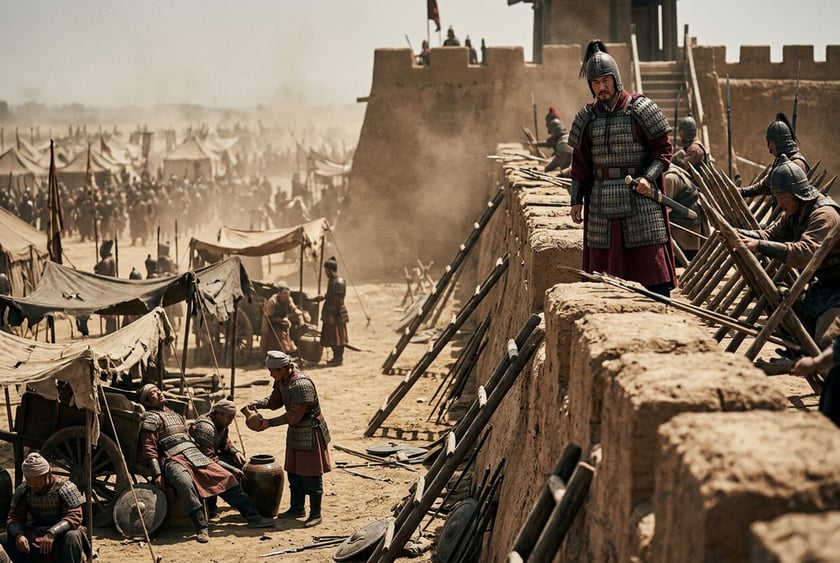
The Battle of Chibi is a rare example in Chinese military history of "strategically overcoming a larger force with a smaller one, and tactically overcoming numbers with cunning" — and it was the turning point that made the San Guo division of power possible. In the first month of the thirteenth year of Jian'an (208), Cao Cao had just pacified Hebei and was shifting his strategic weight southward; in the autumn seventh month he launched his southern campaign against Jingzhou; in the eighth month Liu Biao died, and in the ninth month Liu Cong surrendered the entire province, so that Cao Cao acquired Jingzhou virtually without a fight — and with it the Jingzhou navy — reaching the summit of his power in a single lifetime. From Cao Cao's standpoint, moving downstream at this moment to swallow up Sun Quan and the remnants of Liu Bei's forces was the only remaining window for unifying all under heaven. Even so, Jia Xu had already advised Cao Cao to "rest and reward the officers and soldiers on the strength of the old Chu territories, and pacify the people" rather than rush down into the Yangtze delta; and the annotation by Pei Songzhi specifically notes that even Jia Xu saw the risks, yet for Cao Cao not to advance on the Yangtze delta would have left him unable to bear the dual pressure of Han Sui and Ma Chao in the northwest and Sun Quan in the east. From this angle, the Battle of Chibi was a war Cao Cao "could not afford not to fight"; equally, the Sun-Liu coalition faced an enemy that could not be worn down through prolonged attrition.
Deployment of Both Sides
Cao Cao's side: Cao Cao personally led his northern cavalry in the central army — five thousand strong — in a rapid pursuit of Liu Bei that reached Dangyang Changban and seized his baggage train; he then reorganized his combined naval and land forces and advanced east along the river. Scholarly estimates put Cao Cao's actual forces at around two hundred thousand, a substantial portion of which was the recently surrendered Jingzhou navy — the most serious internal vulnerability in his army, with low loyalty and no experience operating in coordination with his northern infantry and cavalry. The Romance of the San Guo inflated this to eight hundred and thirty thousand, "claiming a million". On the Sun-Liu coalition side: Zhou Yu and Cheng Pu commanded thirty thousand marines as the main force; Liu Bei's own contingent, combined with Guan Yu's naval troops and Liu Qi's Jiangxia forces, numbered roughly ten thousand or more, giving the coalition about forty thousand in total. The battlefield was chosen at Chibi — a stretch of narrow river on the southern bank of the middle Yangtze, with flanking hills — which both negated Cao Cao's numerical advantage through terrain and facilitated the logistics of a fire attack.
Key Decision Points
The entire Battle of Chibi turned on four key decision points. The first was Sun Quan's decision to resist Cao Cao. When Cao Cao's letter arrived at Chaisang, Zhang Zhao and others argued for submission to protect the people of the Yangtze region. Lu Su spoke to Sun Quan privately, pointing out that the ministers who counseled submission could keep their posts, but that Sun Quan, if he surrendered, would have no personal safety to speak of. Zhuge Liang then went to Wu and further provoked Sun Quan's resolve by saying that heroes would "have no place to put their talents"; and Zhou Yu laid out all four of Cao Cao's weaknesses — "troops unaccustomed to water, exhausted from a long march, the north not yet fully pacified, no forage grass for the horses" — whereupon Sun Quan struck the table and committed to resistance. This step pulled Sunwu back from a possible "surrender of the Yangtze region" to "an independent Yangtze region." The second was Huang Gai's recognition of the weakness created by chaining Cao Cao's warships together. Cao Cao had linked the ships end to end to relieve his soldiers' seasickness — a concession to circumstances — but Huang Gai saw in this the possibility of a fire attack. This tactical sensitivity was the product of years of the Wu navy's training on the river. The third was the feigned surrender combined with the fire attack. Huang Gai loaded dozens of light warships with dried grass and oil, sent a letter ahead to Cao Cao pretending to defect, then when the southeast wind rose he drove them at night into Cao Cao's naval and land encampments on the northern bank. Once the fire spread to the shore camps, Cao Cao's infantry and cavalry were thrown into confusion as well, with no time to organize a response. The fourth was Cao Cao's own order to burn his remaining ships before retreating north to Jiangling — a move recorded in both the Annals of Emperor Wu in San Guozhi and the Wu documents, showing that despite his defeat Cao Cao retained considerable command capacity and retreated without disintegrating.
Outcome and Resonance
The immediate result of the battle was Cao Cao's withdrawal north to Jiangling, leaving Cao Ren to defend Nanjun, while the Sun-Liu coalition pressed its advantage and besieged Jiangling; the four southeastern commanderies of Jingzhou — Changsha, Lingling, Guiyang, and Wuling — submitted in succession to Liu Bei. The strategic consequences operated on three levels. The first was the solidification of the tripartite division. Cao Cao's window for unifying the south was permanently closed; thereafter he shifted his strategic focus to Liangzhou and Hanzhong in the northwest, leaving the south to be divided between Sun and Liu. The second was the normalization of the Sun-Liu alliance as the structuring principle of southern politics. The division of labor established at Chibi — Sunwu dominating the waterways, the Liu-Shu forces dominating the overland routes — persisted for seven years until the Xiangshui Treaty, forming the most stable political structure of the early San Guo period. The third was the initial elevation of the economic and political center of gravity of the Chinese south. Before Chibi, China's political and military center had overwhelmingly resided in the Yellow River basin; after Chibi, for the first time in history "southern power was able to block northern unification." This pattern persisted until the Western Jin reunification, then returned in another form after the Yongjia catastrophe.
Counterfactual
The counterfactual paths are not just one. The first: if Sun Quan had listened to Zhang Zhao and advocated submission, the Yangtze region would have come under Cao Cao, Liu Bei could not have held on alone, and Cao Cao could have completed national unification by 209. There would have been no San Guo era and China might have entered a unified empire extending to the end of the third century — but at the cost of suppressing the cultural, gentry, and economic centering of the south for a hundred years. The second: if Cao Cao had taken Jia Xu's advice and not rushed down to the Yangtze but first pacified Jingzhou, no battle of Chibi would have occurred in the winter of 208; but the Sun-Liu alliance would not have formed either. Cao Cao might have subdued the Yangtze region in stages in the 210s, and again the San Guo tripartition would not have emerged — only through a smoother unification process. The third: if Lu Su had not reached Liu Bei at Dangyang in time, and Liu Bei had headed toward Cangwu in the direction of Wu Chen, the Sun-Liu alliance might never have taken shape, and Cao Cao could possibly have crushed the Yangtze region by 209. All three forks share a common feature: the existence of the Battle of Chibi depended on a convergence of contingent conditions — Sun Quan's decision to resist Cao Cao, Zhou Yu's battlefield command, the timely rise of the southeast wind, the outbreak of epidemic disease in Cao Cao's camps. Remove any single link and the outcome would have been different. A battle shaped by this "convergence of multiple contingencies" is extremely rare in Chinese military history, which is also why the Battle of Chibi came to be painted in the Romance of the San Guo with such heavy colors of destiny — narrative devices like "summoning the east wind" are the most vivid literary rendering of this profound contingency.