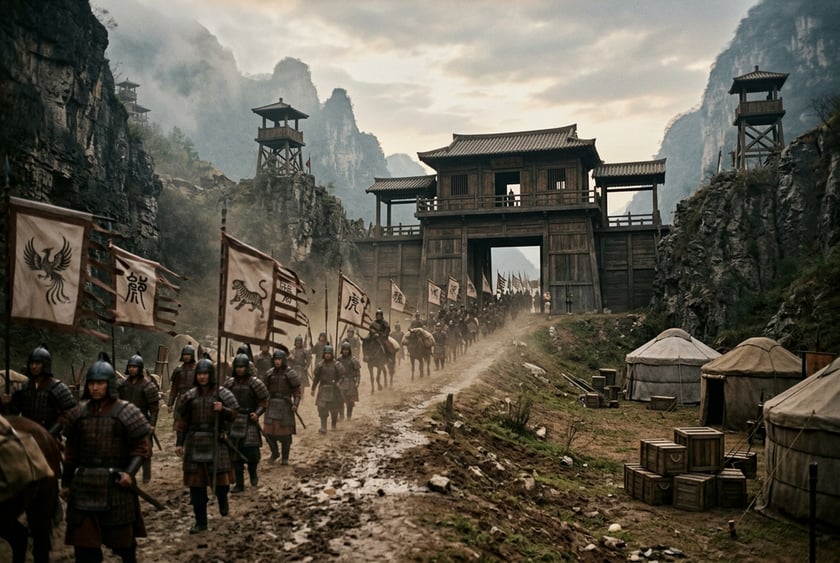
Strategic Background
The fuse of this campaign was the rupture of Wei–Wu relations. Around the time of Yiling, Sun Quan "outwardly professed service to Wei while in truth was disloyal," and when Cao Pi sent envoys demanding a hostage (a son to be sent to court), Sun Quan declined and refused, and the conflict thus came into the open. For Cao Wei, Sun Quan had just dealt a heavy blow to Liu Bei at Yiling and his momentum was at its height—this was the decisive moment to either press him down in one stroke while he was worn out on the western front or sit by and let him grow strong. Cao Pi chose to strike first, his aim being to use the north's advantage in numbers to break open the Yangtze defense line and turn a nominal vassal into a substantive conquest.
Dispositions of the Two Sides
The Wei army adopted a broad-front advance along three routes: on the east Cao Xiu, Zhang Liao, and Zang Ba came out at Dongkou; in the center Cao Ren came out at Ruxu; on the west Cao Zhen, Xiahou Shang, Zhang He, and Xu Huang besieged Jiangling. This disposition aimed to apply pressure at multiple points and disperse the Wu army's relief. Wu set up its defenses along three routes to match: Lü Fan commanded five armies with a naval force to resist Cao Xiu, Zhuge Jin and Pan Zhang relieved Nan Commandery, and Zhu Huan as Commander of Ruxu held off Cao Ren. The key was at Jiangling—Zhu Ran held the isolated city to the death with five thousand battle-worthy troops; the Wei army raised earthen hills, dug tunnels, and erected siege towers up against the walls, with arrows pouring down like rain, yet Zhu Ran calmly heartened his men and, watching for openings, counterattacked and broke two enemy camps, dragging the Wei army's main assault into a war of attrition.
Key Decision Point
The western front was for a time favorable to Wei: Xiahou Shang, having prepared many oil-boats at night, led over ten thousand foot and horse to cross stealthily downstream, burning Zhuge Jin's naval ships along both banks of the river and winning by a combined land-and-water assault. Pan Zhang, on the grounds that "Wei's momentum is just at its height and the river is still shallow; we cannot yet give battle," refused a head-on clash, and instead went upstream to cut reeds and build great rafts, waiting for the waters to rise so as to float fire down to burn the pontoon bridge; Xiahou Shang, sensing the threat, withdrew first. This back-and-forth shows that the Wei army's crossing by pontoon bridge placed its main force in the perilous position of "having its retreat cut off by fire attack," the vital weakness of the whole western front. The central route was more direct—Cao Ren's subordinate general Chang Diao, raiding the central islet, was crushed by Zhu Huan's troops, and the Wu army pressed the advantage to pursue and slaughter them, routing the Wei army.
Outcome and Resonance
In the end all three routes gained nothing. The siege of Jiangling dragged on for months without success, and with a great plague striking as well, Cao Pi issued an edict to withdraw; along the Dongkou line, though the Wu army was struck by a great storm with ships capsizing and thousands of men drowning, it steadied itself because He Qi's detached force alone remained intact; and Zhu Ran thereby gained fame that shook the enemy state and was reenfeoffed as Marquis of Dangyang. This engagement confirmed the dual restraint that the Yangtze and pestilence imposed on northern armies, and turned Wu and Wei into outright enemies; when Cao Pi campaigned in person again two years later as far as Guangling, he still got no further than gazing at the river and sighing.
Counterfactual Speculation
The Wei army's failure stemmed more from structure than from any single misstep. Had Cao Pi not met with plague at Jiangling and been able to hold out another month or two, Zhu Ran—his grain running out, with the internal-collaborator revolt of Yao Tai already appearing in the city—might have been hard pressed to hold for long, and the western front might have been rewritten; but even had Jiangling been taken, the setback in the center at Ruxu and the failure of the navy would still have made the overall design of "the three routes converging to make a surprise strike into Wu territory" hard to realize. The true lesson is this: a broad-front advance by separate columns ought to form combined strength through coordination, yet the Wei army fought along three routes each on its own and was defused by Wu route by route— echoing across time the eastern coalition that likewise lost for lack of coordination, and explaining why northern regimes in the middle Three Kingdoms period could never cross the Yangtze.